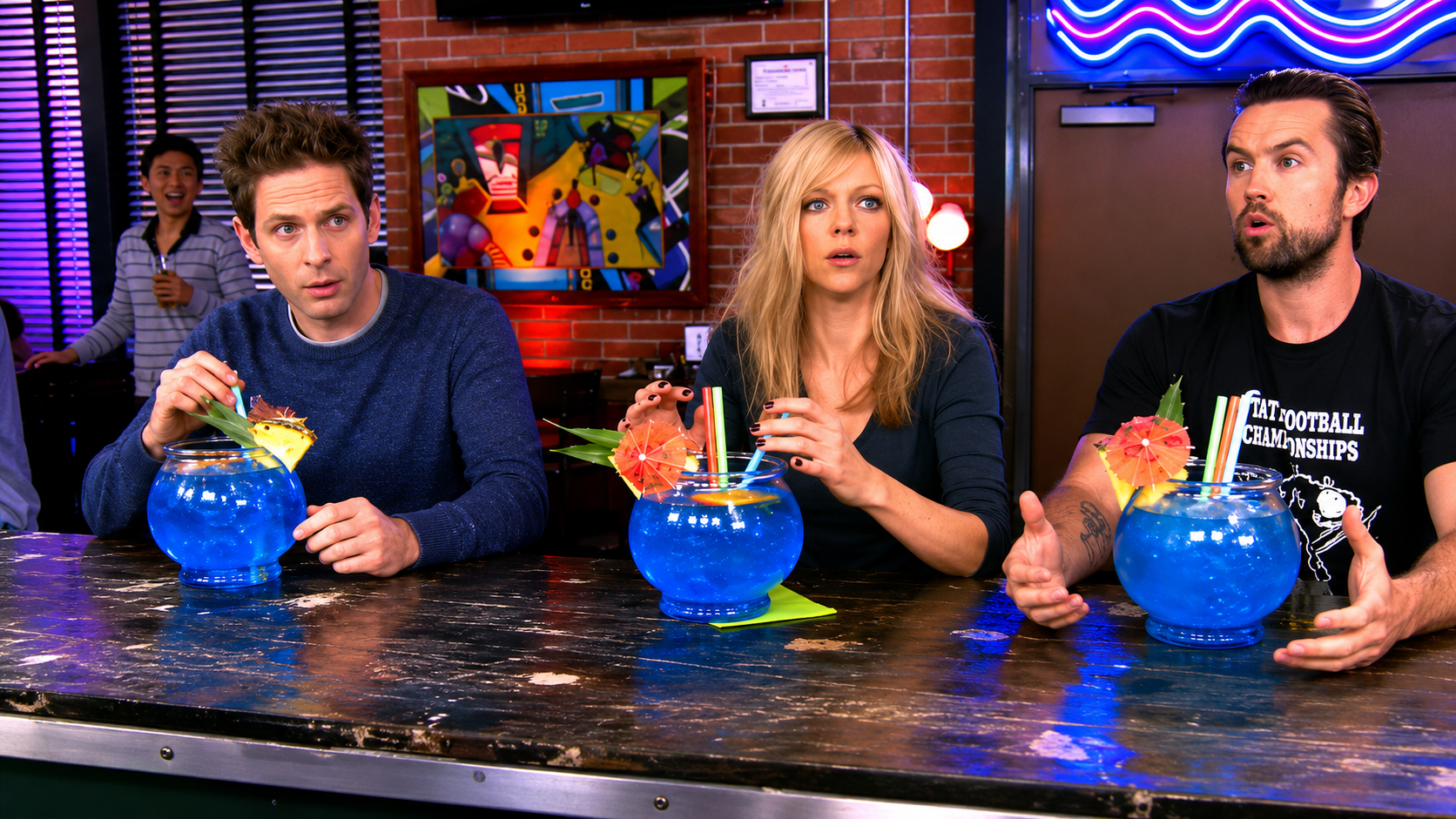
Their questionable choices always lead to anarchic conclusions, both physically and mentally, cleverly subverting their personalities. The plots are also punctuated by visual and logical absurdity to viscerally emphasise this: a roast chicken propped up in cut-off shorts makes an appearance and Mac, a self-professed Catholic, except of course when it comes to doing anything that is actually Christian, goes to a pro-choice women’s protest with the sole mission of sleeping around. Furthermore, as the mania of these characters is the primary focus, the storytelling refuses to follow the typical shiny trajectory of happy endings: a concept the show itself pokes fun at in ‘The Gang Try Desperately to Win an Award’ (pictured). Instead of budding romances, career development and neat solutions, there is animosity, abject failure and inner stagnation.
Courtesy of Fox
The setting of the sitcom is a grimy local pub where the people the group encounter are as damaged as them: the McPoyles are siblings who have an implicitly incestuous relationship, and whether Dennis and Dee’s father, Frank Reynolds (Danny DeVito) is a scheming businessman or suffers genuine dementia is up for querulous debate. However, the self-awareness of the sitcom allows us to walk away feeling amused. Each episode frames the drama through pressing social questions or a nuanced ethical dilemma e.g. the environment, international issues, and the breaking-point of friendship. ‘This throw-away culture we live in’ is a recurrent conscious phrase. This reminds us that the people pulling the strings do in fact possess a moral compass: after all, you must know the boundaries to be able to finely flout them. This also brilliantly contributes to an immersive pantomime experience where the actors of the show know that the audience knows that they are acting: ‘shall I do it?’ is the subliminal dare posed to us as Charlie shovels cat-food into his mouth to better sleep, or when Dee ridiculously performs her Latin alter-ego in “brown-face.” Despite the outrageous contexts, there is always an underlying trust. Summarised as ‘the antidote to nineties sitcoms’ by a Netflix user then, the cynicism of the show has a unique empathetic quality.

The raw depiction of everyday living has become a welcome style. This extends to the very timely exploration of gender equality in the show, both on and off the screen. A recent episode, responds to the #MeToo movement, candidly depicting the difference between authentic alertness and a knee-jerk tribalism which has at once surfaced within the cause. This contests both the normalisation of aggressive sexism and hypocritically reacting with pure venom towards it. Exceptional comedy actress, Kaitlin Olson, is given an equal standing among her male counterparts too. Her professional portfolio is given due diligence alongside the portrayal of complex millennial womanhood. As opposed to being simplistically positioned as a benign guiding force which upholds the traditional cult of maternal womanhood, Dee’s contemporarily feminine character is demonstrated as wayward and outlandish as the rest: the scene where she tries to steal a pair of heels in a covert attempt to look glamorous and goes crashing into a nearby car springs to mind.
Her hilarious female friendship with regular guest character, Artemis (Artemis Pebdani), is also an inimitable highlight. Although there is no warm fuzzy feeling in the typical sense within the show then, an intelligent levity moves in to fill the conceptual space. Reverence through ridicule, originality in pastiche, slapstick yet witty, It’s Always Sunny in Philadelphia is ultimately Shakespeare in the new millennium. Resembling the charismatic comedies of the great bard himself, It’s Always Sunny in Philadelphia is a trailblazing social commentary that not only reflects the relevant concerns of our time, but also unflinchingly exposes them to constructively lift our spirits. The team deserve to win many awards: please give them at least one massive award.